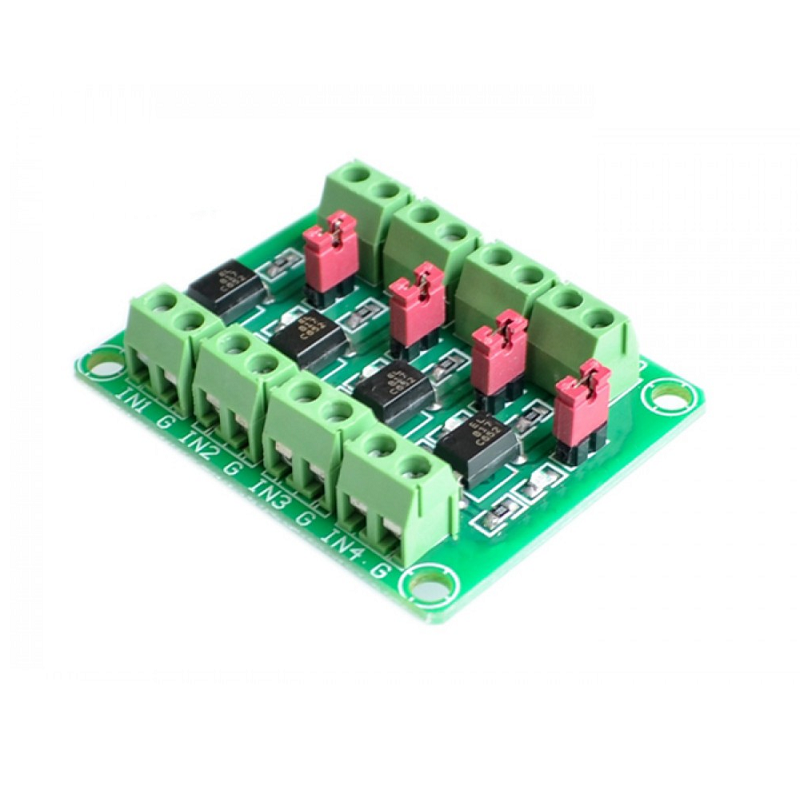
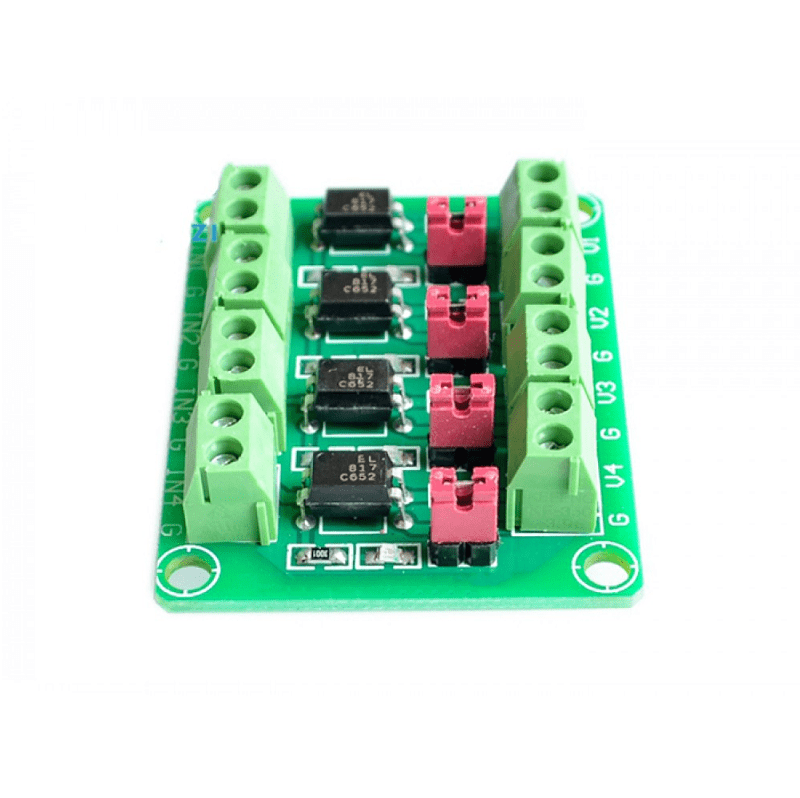
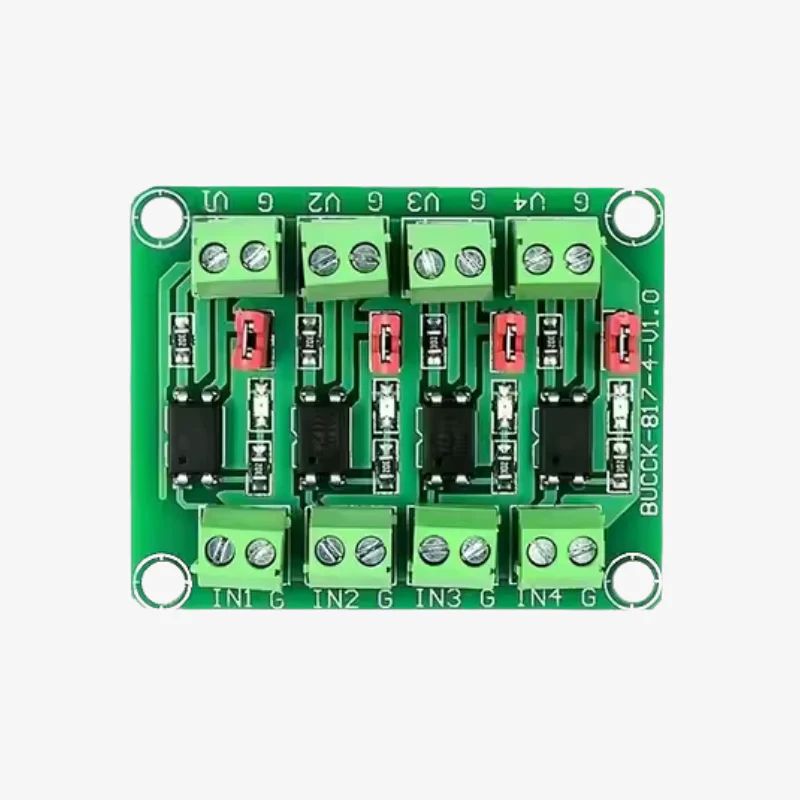
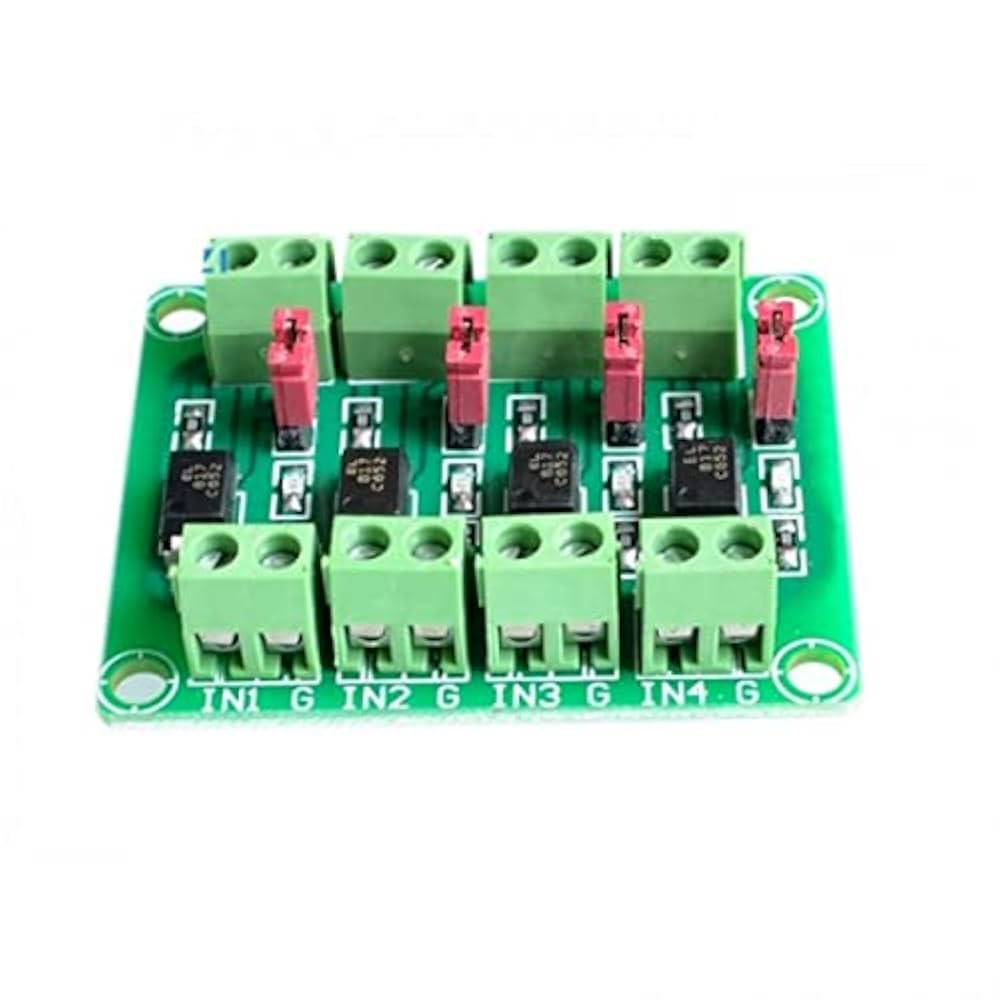
The PC817 4 CH Optocoupler Isolation Module is a versatile board designed to provide a critical safety barrier and noise suppression between two circuits. It utilizes four independent PC817 optocouplers, which use light to transmit a signal while keeping the circuits electrically isolated. This feature is essential when you need to connect a low-voltage microcontroller (MCU) to a high-voltage or noisy circuit, protecting the sensitive MCU from damage. It can also act as a level shifter, allowing you to interface devices with different voltage requirements.
✨ Key Features and Benefits
- **Electrical Isolation**: Provides a safe and reliable way to isolate two circuits, preventing voltage spikes and ground loops.
- **Noise Suppression**: Effectively filters out electrical noise, ensuring a clean signal transmission.
- **Wide Voltage Range**: Supports a wide range of input and output voltages (3.6-24V for driving, 3.6-30V for output), making it highly flexible.
- **Configurable Output**: Jumpers allow you to easily switch between pull-up and pull-down configurations for the output port.
- **Four Channels**: Provides four independent isolation channels on a single board.
🔧 Material and Construction Details
| Component | Details |
|---|---|
| Optocoupler Chip | PC817 |
| Number of Channels | 4 |
| Control Signal | 3.6V - 24V |
| Output Signal | 3.6V - 30V |
📚 Use Cases and Applications
- **Microcontroller I/O Isolation**: Safely connecting MCUs to external devices that operate at different voltages.
- **Industrial Automation**: Used to isolate control signals in noisy industrial environments.
- **Signal Level Shifting**: Converting a signal from one voltage level to another without direct electrical connection.
- **Power Circuit Protection**: Protecting sensitive electronics from high-voltage transients in switching circuits.
🔍 Technical Specifications
| Specification | Details |
|---|---|
| Model Type | PC817 Optocoupler Module |
| Driving Port Voltage | 3.6V - 24V |
| Output Port Voltage | 3.6V - 30V |
| Output Type | Pull-Up/Pull-Down Jumper Selectable |
🧼 Care Information
Handle the module with care to avoid static discharge, which can damage the sensitive optocoupler chips. Ensure all connections are secure and that the module is mounted in a location that is free from excessive moisture or dust. Do not exceed the specified voltage limits on either the input or output ports.
⚠️ Safety Information
While this module provides electrical isolation, it is still crucial to follow proper safety procedures, especially when working with high-voltage or high-current circuits. The module's primary function is to protect the control circuit, but improper wiring of the load circuit can still pose a risk of electric shock. Always ensure power is disconnected when making or changing connections.
👍👎 Pros & Cons
| Pros | Cons |
|---|---|
| Provides crucial electrical isolation for safety. | Can introduce a slight delay in the signal due to the optocoupler's switching time. |
| Excellent for suppressing noise in control circuits. | Not designed to handle high-current loads directly (it is for signal isolation). |
| Offers flexible voltage translation between circuits. | - |
🅿️ Product Images: